 |
 |
 |
|||
|
|
 |
|
 |
|
 |
|
|
|
 |
|
 |
|
 |
|
|
Nixie Elaine Turner | |||||||||
The Nixie in the PondBy the Brothers GrimmOnce upon a time there was a miller who led a pleasant life with his wife. They had money and property, and their prosperity increased from year to year. Calamity, however, can strike overnight. Just as their wealth had increased rapidly, it also began to decrease each year until the miller could hardly call the mill that he inhabited his own. His problems weighed heavily on him, and when he lay down in bed after working all day, he could not rest. Instead he tossed and turned and worried himself sick. One morning he got up before daybreak, went outside into the open air, and hoped that this would ease his heart. As he walked over the dam of the mill the first rays of the sun burst forth, and he heard a rushing sound in the pond. When he turned around, he caught sight of a beautiful woman, who was rising slowly out of the water. Her long hair, which she clasped by her tender hands over her shoulders, flowed down both sides and covered her white body. He realized that this was the nixie of the millpond and became so frightened that he did not know whether to go or stay. But the nixie raised her soft voice, called him by his name, and asked him why he was so sad. At first the miller was distrustful, but when he heard her speak in such a friendly way, he summoned his courage and told her that he had formerly lived in happiness and wealth but was now so poor that he did not know what to do. 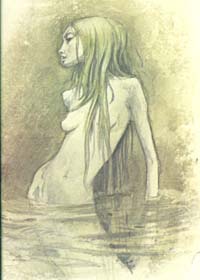
"Calm yourself," responded the nixie. "I shall make you richer and happier than you ever were before. But you must promise to give me what has just been born in your house." That can be nothing but a puppy or a kitten, thought the miller, and he agreed to give her what she desired. The nixie descended into the water again, and he rushed back to his mill feeling consoled and in good spirits. Just as he was about to enter the mill, the main stepped out of his house and shouted that he should rejoice, for his wife had just given birth to a little boy. The miller stood still, as if struck by lightning. He realized that the sly nixie had known this and had deceived him. So he bowed his head and went to his wife's bedside, and when she asked him, "Why aren't you happy about our fine little boy?" he told her what had happened to him and what he had promised the nixie. "What good are happiness and wealth," he added, "if I must lose my child? But what can I do?" Even the relatives, who had come to visit and wish them happiness, did not know what advice to give him. In the meantime, prosperity returned to the house of the miller. Whatever he undertook turned into a success. It was as if the coffers and chests filled themselves of their own accord, and the money kept multiplying overnight in the closet. It did not take long before his wealth was greater than it had ever been before. But he could not rejoice about this with an easy conscience. The consent that he had given to the nixie tortured his heart. Whenever he walked by the millpond, he feared that she might surface and remind him about his debt. He never let his son go near the water. "Be careful," he said to him. "If you just touch the water, she will grab your hand and drag you under." However, as the years passed, and the nixie did not reappear, the miller began to relax. When his boy became a young man, he was given to a huntsman as an apprentice. Once he had learned everything and had become an able huntsman, the lord of the village took him into his service. In the village there was a beautiful and true-hearted maiden who had won the hunter's affection, and when the lord became aware of this, he gave the young man a small house. So the maiden and the huntsmen were married, lived peacefully and happily, and loved each other with all their hearts. Once when the huntsman was pursuing a deer, the animal turned out of the forest and into the open field. The huntsman followed it and finally killed it with one shot. He did not realize that he was close to the dangerous millpond, and after he had skinned and gutted the animal, he went to the water to wash his hands that were covered with blood. No sooner did he dip his hands into the water than the nixie rose up and embraced him laughingly with her sopping wet arms. Then she dragged him down into the water so quickly that only the clapping of the waves above him could be heard. When evening fell, and the huntsman did not return home, his wife became anxious. She went outside to search for him, and since he had often told her that he had to beware of the nixie's snares and that he was never to venture close to the millpond, she already suspected what had happened. She rushed to the water, and when she found his hunting bag lying on the bank of the pond, she could no longer have any doubts about her husband's misfortune. She wrung her hands and uttered a loud groan. she called her beloved by his name, but it was all in vain. Then she rushed to the other side of the millpond and called him again. She scolded the nixie with harsh words, but she received no response. The water's surface remained calm as a mirror. Only the face of the half-moon returned her gaze in stillness. The poor woman did not leave the pond. Time and again she paced around it with quick steps, never resting for a moment. Sometimes she was quiet. Other times she whimpered softly. Finally, she lost her strength, sank to the ground, and fell into a deep sleep. Soon she was seized by a dream. She was anxiously climbing up a mountain between two huge cliffs. Thorns and briars pricked her feet. Rain slapped her face, and the wind whipped through her long hair. When she reached the peak, there was an entirely different view. The sky was blue; the air, mild. The ground sloped gently downward, and a neat little hut stood on a green meadow covered by flowers. She went toward the hut and opened the door. There sat an old woman with white hair, who beckoned to her in a friendly way. At that very moment the poor young woman woke up. The day had already dawned, and she decided to let herself be guided by the dream. So she struggled up the mountain, and everything was exactly as she had seen it in the night. The old woman received her in a friendly way and showed her a chair where she was to sit. "You must have had a terrible experience," the woman said, "for you to have searched out my lonely hut." The young woman cried as she told her what had happened to her. Then the old woman said, "Console yourself, for I shall help you. Here is a golden comb. Wait until the full moon has risen. Then go to the millpond, sit down on the bank, and comb your long black hair with this comb. When you're finished, set it down on the bank, and you'll see what happens." The woman returned home, but she felt that the full moon was very slow in coming. Finally, it appeared in the sky. So she went out to the millpond, sat down, and combed her long black hair with the golden comb. And, when she was finished, she set it down on the edge of the water. Soon after, a bubbling from the depths could be heard, and a wave rose up, rolled to the shore, and took the comb away with it. The comb sank to the bottom in no time. Then the surface of the water parted, and the head of the huntsman emerged in the air. He did not speak, but with a sad look he glanced at his wife. At that very moment, a second wave rushed toward the man and covered his head. Everything disappeared. The millpond was as peaceful as before, and only the face of the full moon shone upon it. The young woman returned home disheartened. However, the dream came back to her and showed her the old woman's hut. The next morning she set out on her way once again and related her woes to the wise woman, who gave her a golden flute and said, "Wait until the full moon comes again. Then, take this flute, sit down on the bank, play a beautiful tune, and after you're done, lay it down on the sand, and you'll see what happens." The huntsman's wife did what the old woman told her to do. Just as she set the flute on the sand, there was a sudden bubbling from the depths. A wave rose up, moved toward the bank, and took the flute away with it. Soon after, the water parted, and not only the head of the man became visible but also half of his body. He stretched out his arms toward her yearningly, but just as he did this, a second wave rolled by, covering him, and dragged him down into the water again. "Oh, what's the use!" exclaimed the unfortunate woman. "I'm given glimpses of my dearest only to lose him again!" Grief filled her heart anew, but the dream showed her the old woman's hut for a third time. So she set upon her way again, and the wise woman comforted her, gave her a golden spinning wheel, and said, "Not everything has been completed yet. Wait until the full moon comes, then take the spinning wheel, sit down on the bank, and spin until the spool is full. When you're finished, place the spinning wheel near the water, and you'll see what happens." The young woman followed the instructions exactly as she had been told. As soon as the full moon appeared, she carried the golden spinning wheel to the bank and spun diligently until there was no more flax left and the spool was completely full of thread. But, no sooner was the spinning wheel standing on the bank than the water bubbled in the depths more violently than ever before. A powerful wave rushed to the shore and carried the spinning wheel away with it. Soon after, the head and entire body of the man rose up high like a water geyser. Quickly he jumped to the shore, took his wife by the hand, and fled. But they had gone barely a short distance when the entire millpond rose up with a horrible bubbling and flowed over the wide fields with such force that it tore everything along with it. The two escapees could already picture their death. Then, in her fear, the wife called to the old woman to help them, and at that very moment they were transformed; she into a toad, he into a frog. When the flood swept over them, it could not kill them, but it did tear them apart from each other and carry them far away. After the flood had run its course, and both had touched down on dry land, they regained their human shape. But neither one knew where the other was. They found themselves among strange people, who did not know where their homeland was. High mountains and deep valleys lay between them. In order to earn a living, both had to tend sheep. For many years they drove their flocks through fields and forests and were full of sadness and longing. One day, when spring had made its appearance on earth again, they both set out with their flocks, and as chance would have it, they began moving toward each other. When the huntsman caught sight of another flock on a distant mountain slope, he drove his sheep in that direction. They came together in a valley, but they did not recognize each other. However, they were glad to have each other's company in such a lonely place. From then on they drove their flocks side by side every day. They did not speak much, but they felt comforted. One evening, when the full moon appeared in the sky and the sheep had already retired for the night, the shepherd took a flute from his pocket and played a beautiful but sad tune. When he was finished, he noticed that the shepherdess was weeping bitterly. "Why are you crying?" he asked. "Oh," she answered, "the full moon was shining just like this when I last played that tune on a flute, and the head of my beloved rose out of the water." He looked at her, and it was as if a veil had fallen from his eyes, for he recognized his dearest wife. And when she looked at him and the light of the moon fell on his face, she recognized him as well. They embraced and kissed each other. And nobody need ask whether they lived in bliss thereafter
|
|||||||||||